
Running a Sex Offender Check in Menard County
The Texas Public Sex Offender Registry is the main public search channel for Menard County. It is free and does not require an account for a basic search. Begin with the county filter when the goal is a broad local review. Use the name route when both the first and last name are known. An exact-address route can test one street location, and map or list controls help the reader scan results from different angles. No separate Menard County registry map or local list was found in the official sources, so the DPS record is the online starting point.
The Menard County Sheriff's Office performs the local registration function at 208 Tipton. Call 325-396-4705 before going because the office posts no registration-desk hours or appointment rule. A caller can ask which agency verifies a profile, how to report a possible error, or where a person who lives inside the City of Menard must report. That last point matters because the research found no current active city police page. It is safer to confirm the assigned authority than to guess from a city address.
Menard County Registry Search Paths
The DPS form offers several paths, and each answers a different question. A county search casts the widest Menard County net. A name search is best when the spelling is known. An exact-address search tests one place, while the school search works through an institute and a campus choice. These searches do not prove that every record will plot on the map. Software limits and address variations can leave a valid profile in the Unmapped group.
The official DPS search screen shows the public name and location controls used for a Menard County registry check.
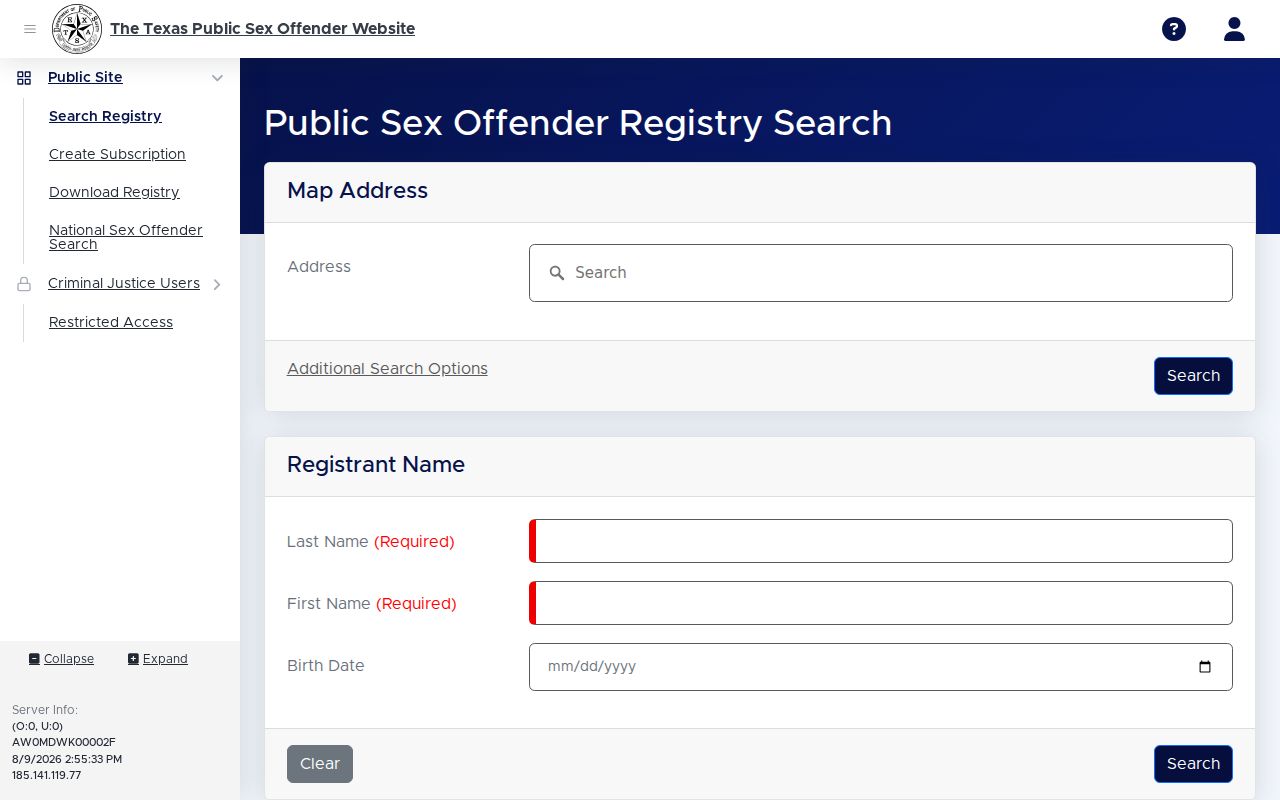
The screen is the practical first stop, but its map and list views should be checked together before drawing a conclusion.
Searching the Texas Public Sex Offender Registry
DPS maintains Texas profiles and publishes the search rules. Gather only what is needed before beginning. A name route calls for both first and last name, with birth date available as an added identifier. A location search can use city, county, ZIP, or an address route. Review the warning and conditions on the portal, then compare the result details instead of relying on a name alone.
- Open the DPS registry search and read the conditions of use.
- Choose name, address, county, ZIP, or school search based on the fact already known.
- Set Menard County or Menard as the location, then review both mapped and Unmapped results.
- Open the matching profile, read its verification agency and dates, and contact that agency about an error or suspected noncompliance.
| Field Label | Type | Required | Notes |
|---|---|---|---|
| Last Name | Text | Yes in name mode | Use the known legal spelling. |
| First Name | Text | Yes in name mode | Texas unusually requires both names. |
| Birth Date | Date | No | Helps separate similar names. |
| City / County / ZIP | Text or selection | Route-dependent | Use Menard or Menard County for local results. |
| Exact Address | Address fields | Yes in address mode | Street number, street name, city, TX, and ZIP are required. |
| Map / List | View control | No | Also inspect the Unmapped category. |
Menard County Registry Map Gaps
An address pin is a search aid, not proof that the map is complete. DPS warns that some Texas records cannot be mapped because of address forms or software limits. Someone checking an area in Menard County should therefore run more than one location route. Compare the exact address with a city, ZIP, and county search, and open Unmapped results when that option appears. The same care applies to a result near a school or other landmark.
The DPS exact-address form shows the fields needed for a location-based search.
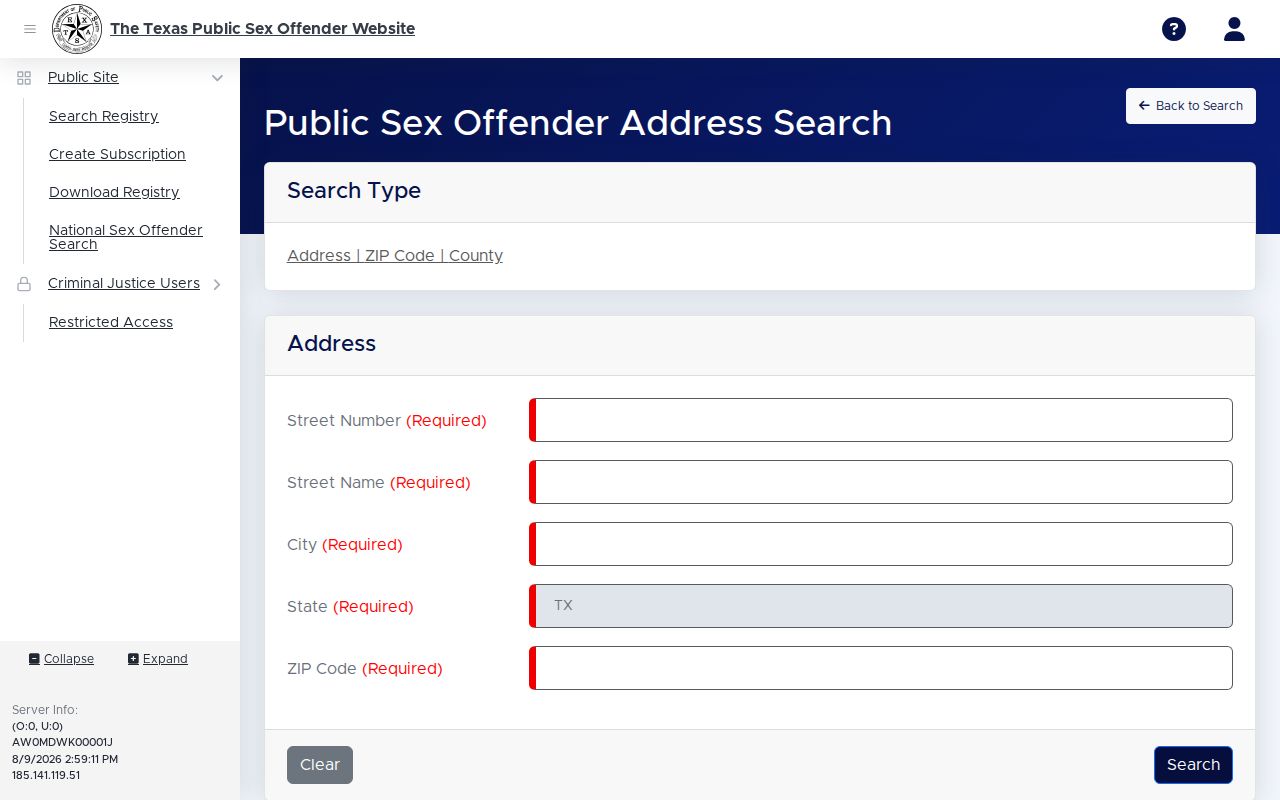
This route works best as one layer of the check, followed by the county list and profile-level verification.
What a Registry Profile Shows
A public Texas profile combines identity, location, status, and reportable-offense data. It can show a current photograph, aliases, a physical description, scars or marks, an address, vehicle data, the reportable offense, and the numeric risk level. Registration and verification dates help place the entry in time. Read those dates and the verification agency together. A profile is not the whole court file, and an offense label alone does not explain every order or later event in the case.
| Name & Aliases | The registered name and other names published for identification. |
|---|---|
| Photo & Physical Description | Current photograph plus sex, race, age or birth-date presentation, height, weight, hair, eyes, scars, marks, and tattoos where reported. |
| Registered Address | The public location data allowed by Chapter 62, sometimes with added location or vehicle information. |
| Offense & Statute | The reportable offense, jurisdiction, conviction or adjudication date, and victim category when release is allowed. |
| Risk Level | Texas numeric level one, two, or three, or a civil-commitment designation when applicable. |
| Registration Status | Registration and verification data plus the agency responsible for the entry. |
Article 62.005 keeps several sensitive fields out of the public display. Those exclusions include Social Security and driver's-license numbers, phone numbers, certain online identifiers, and employer contact information. Their absence is a legal limit, not a sign that the Menard County registry result is unfinished.
Menard County Registry and NSOPW
The DPS and national searches serve different scopes. DPS is the primary source for Texas profile details and corrections. The U.S. Department of Justice's National Sex Offender Public Website, or NSOPW, sends one query across participating jurisdictions. That broader layer is useful when a person may have moved across state lines or when a Menard County address is only one part of the search.
The official NSOPW portal displays its multi-jurisdiction name, ZIP, and radius tools.
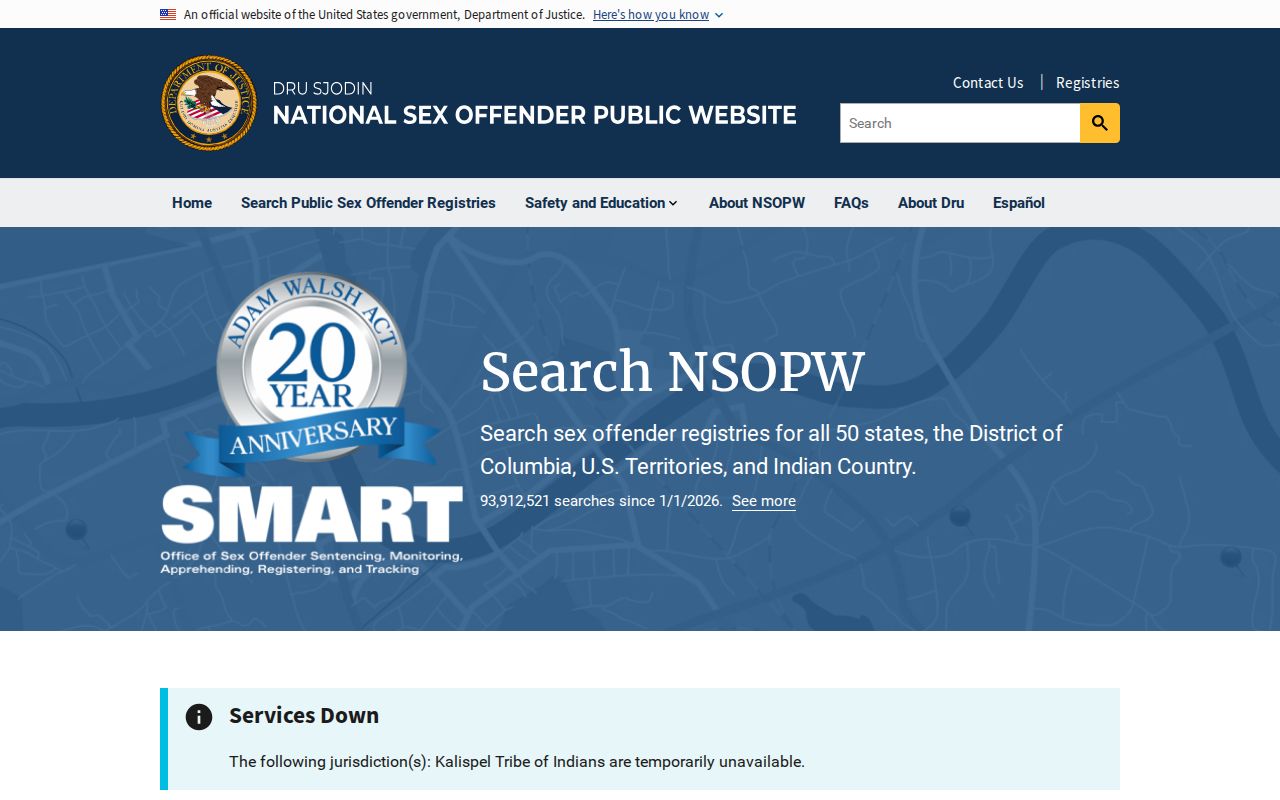
NSOPW broadens the search, while the linked Texas profile remains the better source for Texas-specific status and correction questions.
NSOPW accepts first and last name or a ZIP code, with optional county and city filters. It can search up to five ZIP codes and can include all states, territories, and Indian Country. Its radius mode depends on location coordinates supplied by participating jurisdictions. For that reason, a national radius result has the same basic limit as a state map: missing coordinates can affect what appears around a point.
Registration Requirements and Levels in Texas
Texas risk levels and registration length answer two separate questions. The numeric level describes assessed danger or likelihood of reoffense. It does not set the end date by itself. Chapter 62 ties duration to the reportable offense and other legal facts. Many adult duties last for life, while listed offenses carry a ten-year period after release or supervision ends. Juvenile duties generally last ten years after disposition or completion, subject to the statute and court orders.
| Level or Duty | Meaning or Duration | Verification Context |
|---|---|---|
| Level 1 | Low assessed risk; not a duration tier | Generally annual unless another rule applies |
| Level 2 | Moderate assessed risk; not a duration tier | Generally annual unless another rule applies |
| Level 3 | High assessed risk; notice rules may be broader | Generally annual unless another rule applies |
| Lifetime duty | Applies to offenses listed in Article 62.101(a) | Frequency depends on current statutory status |
| Ten-year adult duty | Runs after the release or supervision endpoint for listed offenses | Frequency depends on current statutory status |
| Juvenile duty | Generally ten years after disposition or completion | Subject to statutory and court exceptions |
DPS describes more frequent verification for some groups. Civilly committed registrants report every thirty days, while people with two or more sexually violent offenses report every ninety days. Remaining registrants generally verify each year, subject to the current text of Article 62.058. A Menard County profile should be read against its actual status, not forced into a federal tier model Texas does not use.
Menard County Sheriff's Registry Role
The local registration point is the Menard County Sheriff's Office. It is based with the jail at 208 Tipton, Menard, Texas 76859, and the listed phone is 325-396-4705. The county posts no separate registry-desk hours, local registry app, or appointment page. Call first. That simple step avoids a wasted visit and lets the office confirm whether it is the verification agency for the address in question.
Menard County Sheriff's Office
208 Tipton
Menard, TX 76859
325-396-4705
Local registration, verification-agency questions, and safe reports of possible noncompliance. Call before visiting.
Report a suspected failure to register or an apparent profile error to the verification agency shown on the record. Give the precise concern and the public profile reference. Do not investigate a residence or confront anyone. DPS handles the state database, while the Menard County Sheriff's Office handles local registration facts assigned to it.
Menard County Registry Notification
Texas notification varies with legal status and risk. The state may mail bilingual postcards to nearby homes and businesses for certain high-risk or civilly committed releases or moves. Statutory school notices also apply to defined categories. A level-three label can affect the type of notice, but a map pin alone does not show that every notice rule was triggered.
DPS also offers an account-based subscription that emails database changes tied to registered persons. That service differs from the free public search, and the download or export function also requires an account. Menard County residents who use alerts should still open the current profile when a notice arrives. The profile's source agency and verification date give the context that a short email cannot.
Lawful Use and Community Notification
Registry information supports community awareness, family safety planning, and informed contact with public agencies. It should be used with care. Texas does not impose one universal statewide residence-distance rule merely because a person is registered. A supervision condition, court order, or valid local ordinance may add a restriction, but no Menard-specific distance ordinance was located. Confirm the actual rule before assuming that an address is unlawful.
Chapter 62 misuse warning: Texas Code of Criminal Procedure Chapter 62 warns that using registry information to injure, harass, threaten, or commit another unlawful act can lead to criminal prosecution or civil liability. Report concerns to the listed verification agency. Do not confront a registrant.
Public notice is not a license for vigilantism or discrimination. If a Menard County entry seems stale, the sound response is to note the profile, date, and agency, then contact the Menard County Sheriff's Office or DPS. A careful report protects the caller and gives the responsible agency enough detail to review the record.